
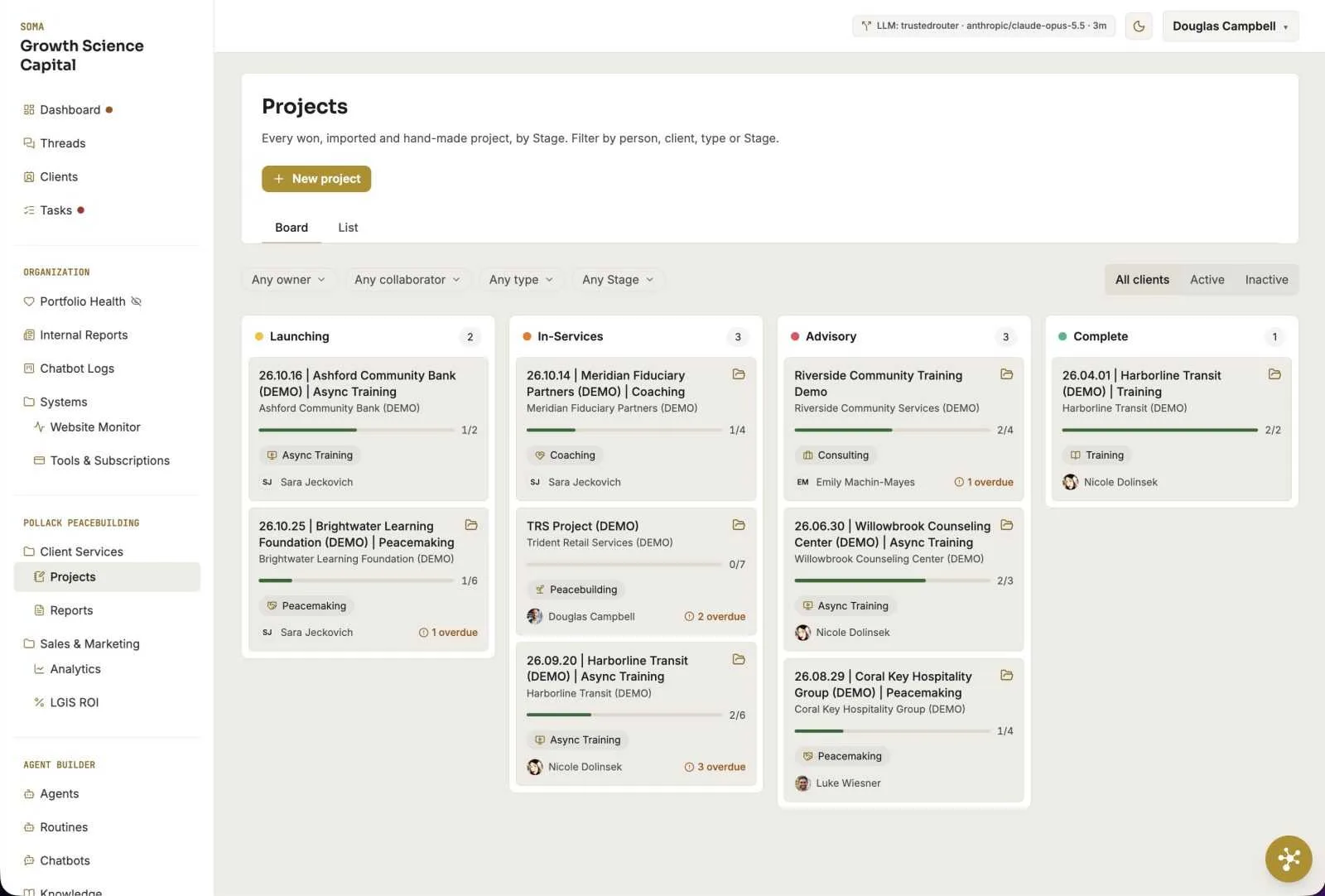

This week, I've been building a simpler version of ClickUp for one of my consulting clients. It handles how their team assigns projects and tasks, and it's going to save them hundreds of dollars a month in team seats.
The starting point wasn't a list of everything ClickUp can do. It was a conversation about what this team actually needs to get its work done.
That's a much smaller brief. It's also a more useful one.
Like everything I build for them, the tool sits inside my custom consulting platform, hosted on a cloud VPS so their data is isolated. I've also set them up with encrypted AI models, so their data stays private even when it's being processed by AI.
Piece by piece, we're moving from legacy systems to tools built around their business. This project is a good example of why I think the way companies buy software is changing.
THE BUY OR BUILD QUESTION HAS CHANGED
For years, buying software was the practical choice for most teams. Building your own meant finding developers, setting aside a budget and accepting a long wait before anyone could use it.
AI is changing that calculation. Individuals and teams can now direct AI to build the specific tool they need. There's still work involved in getting it right, but building has become an option for problems that previously wouldn't have justified it.
This is already affecting purchasing decisions. In McKinsey's 2026 State of AI survey, 32 percent of respondents say their organizations decided against buying at least one software product or feature because they could build it in-house with agentic coding tools. Nearly half of AI "high performers" said so.
In February, Business Insider reported that Netlify's CEO said his own employees were using AI to build internal replacements for SaaS products, including survey and quoting tools.
These are everyday business needs. They're also the kinds of tools teams have been renting for years without much reason to consider another approach.
START WITH HOW YOUR TEAM WORKS
For me, the biggest benefit comes before the cost savings: you can build around the way a team actually works.
Generic software has to serve lots of different customers. That means offering settings, features and workflows that some teams need and others never use. Your team then has to figure out which parts matter and how to make them fit.
With a custom tool, I can start with the work itself. Who assigns a project? What does someone need to see when they open a task? Where does a handover get confusing?
Those answers shape what gets built.
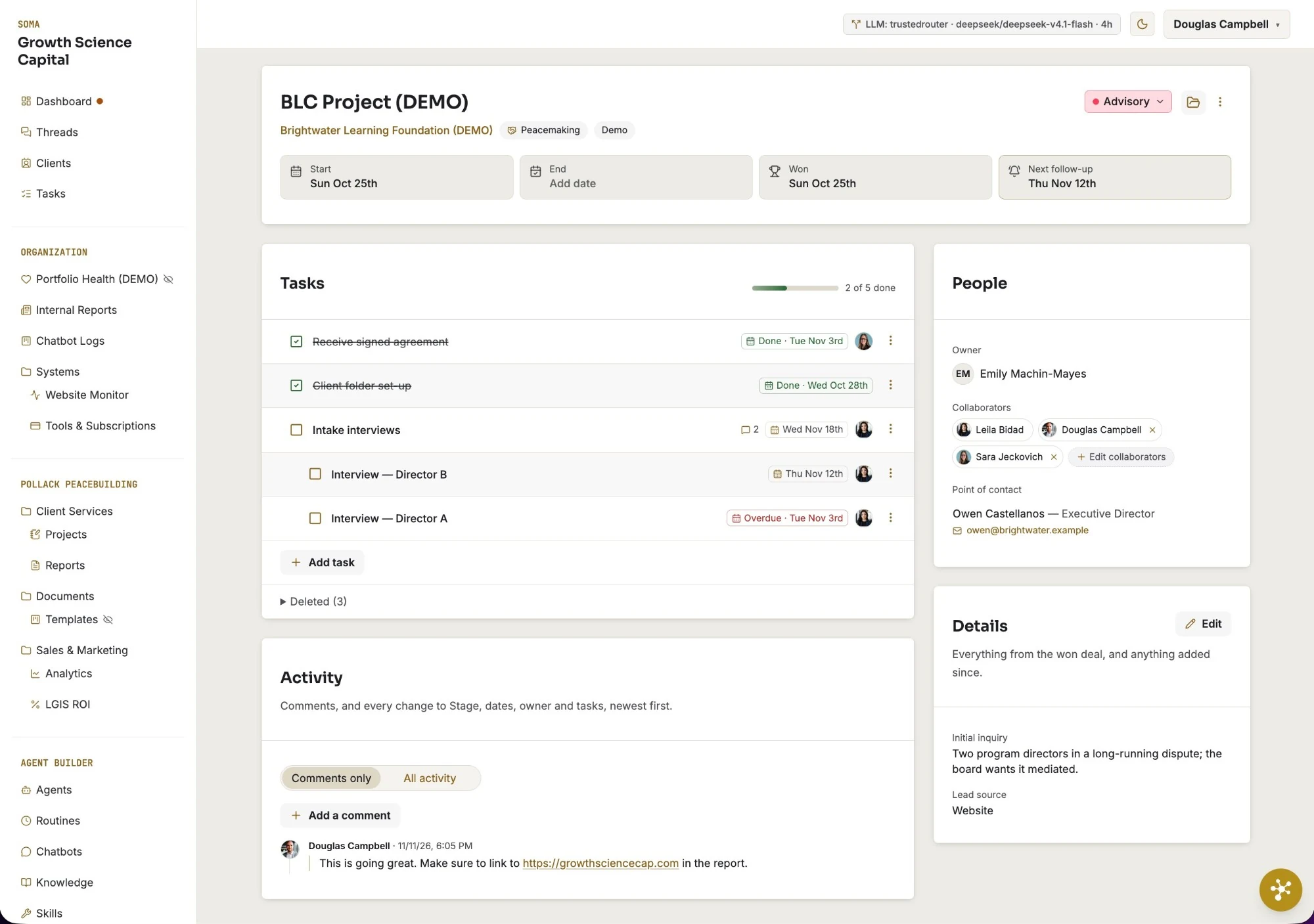
Inside the custom projects tool: one project's tasks, owners, due dates and people on a single page.
That's the approach I'm taking with this ClickUp replacement. I'm building the project and task management this client needs, with room to adjust it as their needs change.
A simpler tool can be a better tool when the things it leaves out were only getting in the way.
THE SEAT BILL ADDS UP
Customization is a strong reason to consider this. The cost can make the decision even clearer.
Take a team of 100 people paying $25 a seat. That's $2,500 a month, or $30,000 a year, for one tool.
If that tool is rebuilt as a custom tool inside your own self-hosted platform, built for your team, that seat bill goes away.
The software still has costs. Someone needs to build it, host it and maintain it. But those costs can be compared with the subscription you're replacing, rather than assuming a recurring seat charge is unavoidable.
And most teams pay for many tools, not one.
According to Zylo's 2025 SaaS Management Index, SaaS spend averages $4,830 per employee, up 21.9% year over year. That makes it worth looking closely at what your team uses and what you're paying to keep available.
I wouldn't assume all of that spending can disappear. I would ask how much of it pays for straightforward functions that could live inside a platform you control.
WHAT TO REPLACE AND WHAT TO KEEP
I don't think every software product should be replaced.
Big, deep systems can still be worth buying. Their value may come from years of specialist development, reliable support, complex integrations or capabilities that would be expensive to recreate and maintain.
For a useful counterpoint to predictions that SaaS is about to disappear, read Fortune's “Wall Street is convinced AI will kill SaaS. History and economics say something else.”
The sweet spot I see is simpler tools where you're paying per seat for a lot of features you don't use.
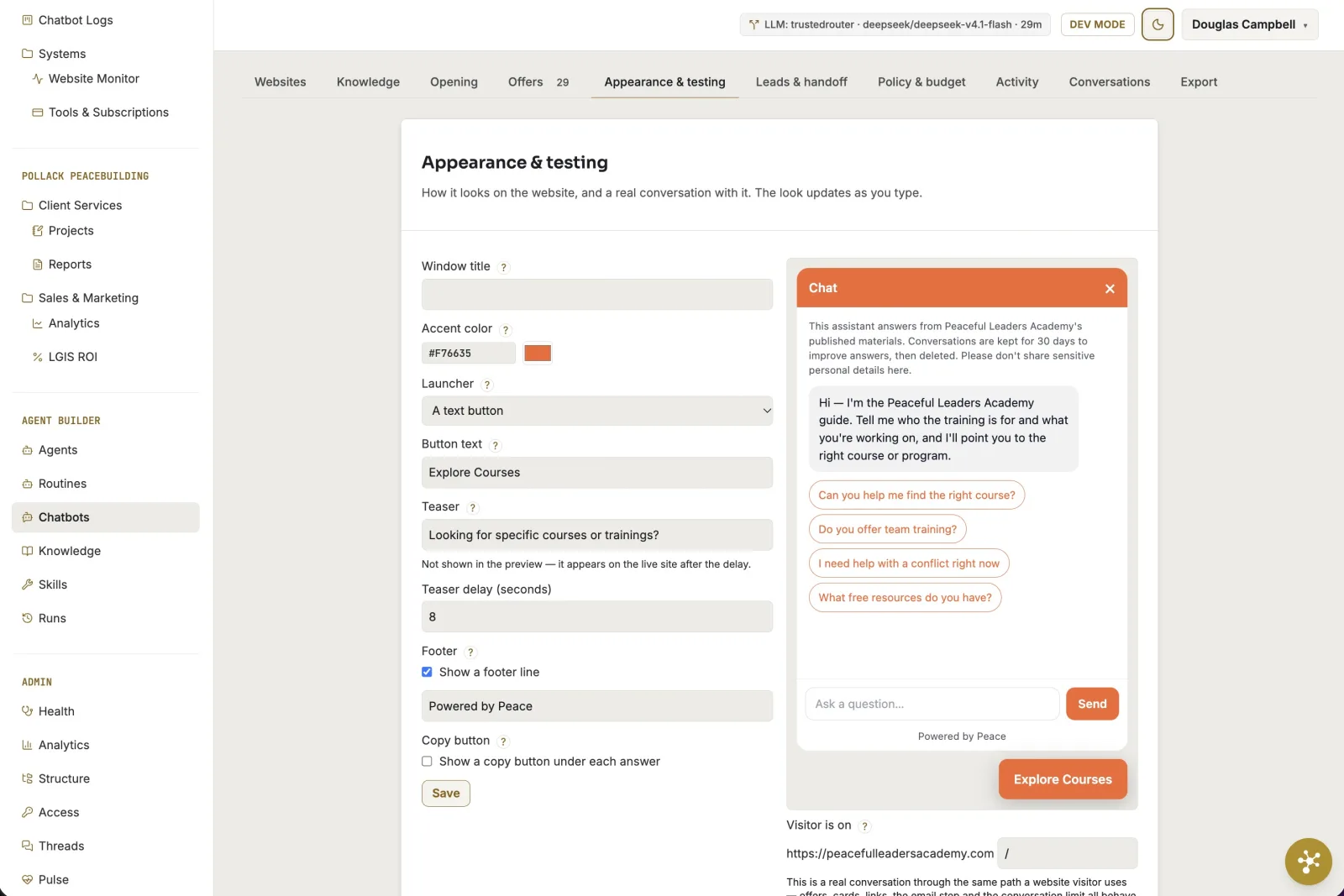
Another subscription replaced: a custom chatbot creator for websites, built into the same platform.
Maintenance belongs in that decision from the beginning. Custom tools need updates, fixes and someone responsible for keeping them useful. That's part of what I do for my clients, alongside building them.
OWNERSHIP MAKES A DIFFERENCE
For this client, the tools and data live on their own isolated cloud server, inside the platform I described in Launching the Soma Platform.
Their AI use runs through encrypted, private models, with model choices managed within the same environment.
When they need a change, we can make it fit their workflow. They don't have to wait for a vendor to decide that enough other customers want the same thing.
That also gives us a practical foundation for the agentic future, where AI can help carry out work across their tools. We're getting there through useful changes to the systems they use today.
WHAT COULD YOUR TEAM BUILD?
I build these custom tools through my agentic studio RAIZOR. The work starts with understanding the team, the workflow and where the current software falls short.
If you're paying for tools that feel too complicated, too expensive or poorly suited to how you work, get in touch. I'd be happy to look at what you're using and help you work out which custom tools could make sense for you and your team.