There’s been a MASSIVE development in the world of quantum computing, which would enable exponentially faster data processing, from encryption to AI training & inference. In tests, Google’s new “Willow” chip can calculate “a standard benchmark computation in under five minutes that would take one of today’s fastest supercomputers 10 septillion (that is a 1 with 25 zeros after it) years — a number that vastly exceeds the age of the Universe.” Try getting your head around THAT!
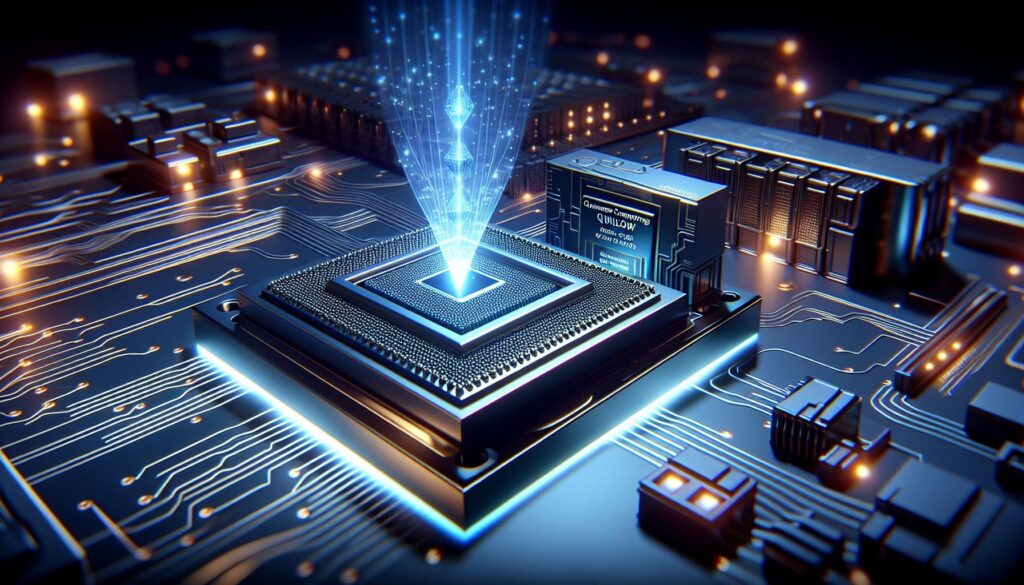
Today, we’re diving into the world of quantum computing, focusing on Google’s latest innovation, the Willow quantum chip. This breakthrough was shared by Hartmut Neven, the Founder and Lead of Google Quantum AI, and it’s a big step forward in the quest to build a large-scale quantum computer. The Willow chip is notable for its ability to reduce errors exponentially as more qubits are added, addressing a challenge that has puzzled researchers for nearly three decades.
Key Achievements
Willow’s standout feature is its error correction capability. It can cut the error rate in half each time the grid of qubits is expanded, demonstrating a significant reduction in errors. This achievement, known as “below threshold,” is a milestone in quantum error correction, a concept introduced by Peter Shor back in 1995. Additionally, Willow completed a benchmark computation in under five minutes, a task that would take one of today’s fastest supercomputers 10 septillion years. This performance suggests that quantum computing might be operating on a level that classical computers simply can’t match.
Why It Matters
The Willow chip is a glimpse into the future of computing. By reducing errors and outperforming classical computers in specific tasks, it paves the way for practical applications that could benefit society. Quantum computing holds promise for advancing scientific discovery, developing new applications, and tackling complex challenges. The Willow chip’s performance on the random circuit sampling (RCS) benchmark, a standard for assessing quantum computers, underscores its potential.
Benefits and Challenges
Quantum computing, as demonstrated by Willow, offers several benefits. It can potentially solve problems that are currently beyond the reach of classical computers, opening doors to new scientific discoveries and applications. However, challenges remain. Error correction is still a significant hurdle, and the technology needs to demonstrate real-world applications that are beyond classical capabilities. Moreover, as quantum computers scale up, ensuring the quality of qubits remains a priority.
Potential Business Use Cases
- Quantum Drug Discovery: Develop a platform that uses quantum computing to simulate molecular interactions, accelerating the discovery of new medicines.
- Advanced Battery Design: Utilize quantum algorithms to design more efficient batteries for electric vehicles, improving energy storage and sustainability.
- Financial Modeling: Create a service that leverages quantum computing to optimize complex financial models, offering insights that are currently unattainable with classical methods.
As we consider the advancements brought by the Willow chip, it’s clear that quantum computing is on the brink of changing how we approach complex problems. While the potential benefits are vast, the journey is not without its challenges. The balance between harnessing this technology’s power and addressing its limitations will shape its impact on our world. As we move forward, it’s crucial to keep an open mind about the possibilities and remain vigilant about the challenges that lie ahead.
—
You can read the original article here.
Image Credit: DALL-E
—
I consult with clients on generative AI-infused branding, web design, and digital marketing to help them generate leads, boost sales, increase efficiency & spark creativity. You can learn more and book a call at https://www.projectfresh.com/consulting.